
Article / Public
Google says it demonstrated magic state cultivation on its Willow processor
Google reports about a 40-fold error reduction and T-states with 99.99% logical fidelity in its Willow magic state cultivation experiment. The method still needs a larger-scale demonstration for practical use.
Google Quantum AI announced that it demonstrated “magic state cultivation” on its Willow quantum processor. In work it says was published in Science on October 15, 2026, the company reports reducing errors about 40-fold compared with uncultivated states. According to Google, the experiment also produced T-states with 99.99% logical fidelity. The work focuses on preparing special states needed for quantum computing and then transferring them to a different error-correction code. The announcement therefore covers both preparation and moving the prepared states within the processor.
Why preparation costs matter
According to Google's account, universal quantum computing requires running specific quantum operations and correcting errors in those operations. Special quantum states called “magic states” help create the required operations. Preparing high-quality, error-corrected states, however, takes substantial resources. A magic state also cannot be reused once consumed.
The company cites estimates suggesting that this preparation could take up to 95% of a quantum computer's capacity. That figure is not measured resource consumption from the Willow experiment; the announcement uses it to describe the scale of the problem. The research aims to prepare these necessary states with fewer resources. Reducing the preparation burden is intended to leave more capacity for actual computation.
From a noisy state to a purified state
- Noisy starting point
An initial quantum state is injected into a small region of the chip.
- Coordinated measurements
Measurements check for errors and discard flawed attempts.
- Purified state
The low-error state is adapted into a larger encoding.
The method works like a filter
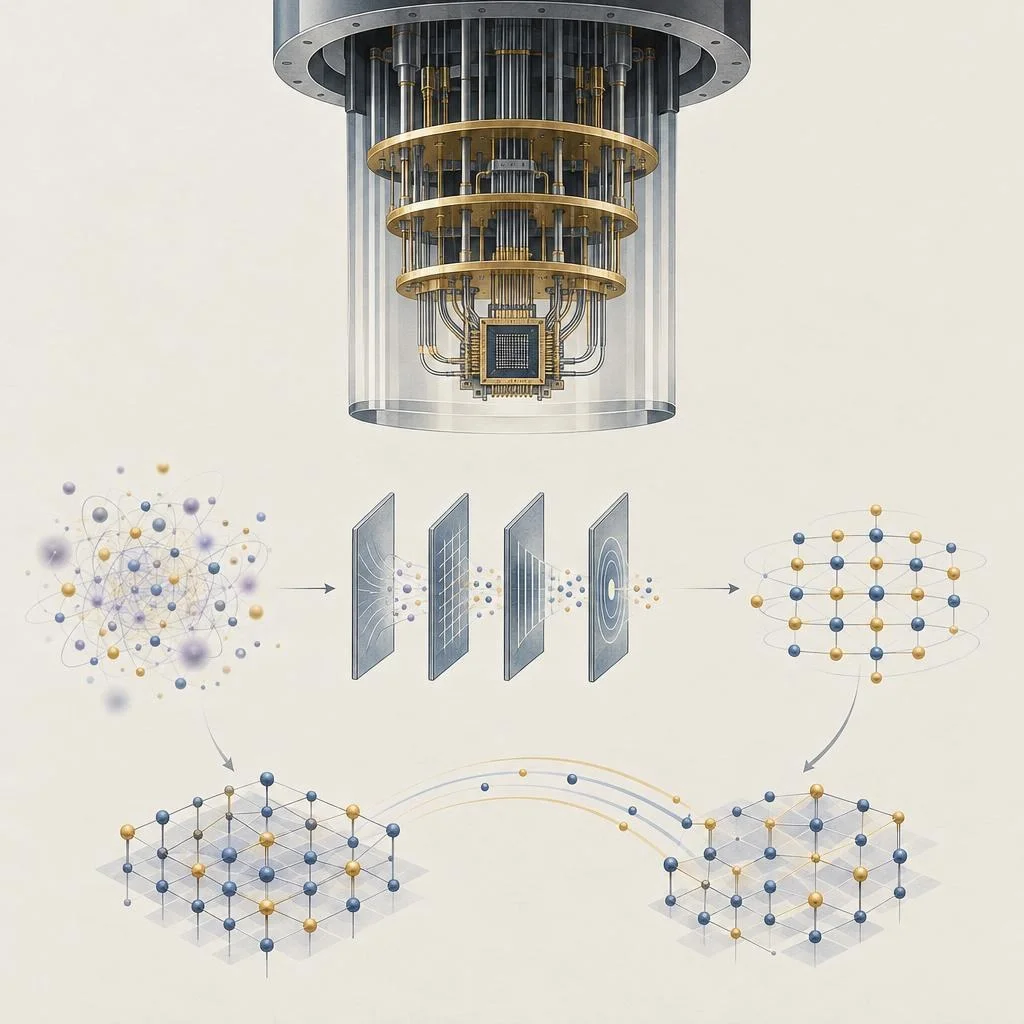
Google compares cultivation to a filter. First, a noisy quantum state is injected into a small region of the chip. Coordinated measurements then check for errors and discard flawed attempts. The aim is to obtain a low-error state while adapting it into a larger, useful encoding.
According to the company, Craig Gidney, Noah Shutty and Cody Jones developed the approach in 2024 by refining an idea from the literature. The Willow work represents the step of implementing that theoretical method on hardware. The filter described here is a conceptual explanation of the measurement and selection process used to move from a noisy starting state to a cleaner one. It involves complementary operations rather than a single measurement.
The measurement method changed too
Google says an assumption in its initial measurement technique caused problems during early tests. Laboratory noise associated with electrical equipment drift and temperature variation affected the benchmark's validity. The company reports adding system controls to reduce that effect.
The team also developed a new benchmarking technique that uses cultivation to measure its own performance. This detail matters for understanding how the reported result was obtained: The work covers both the state-preparation protocol and the measurement approach used to evaluate its output. Google's reported 40-fold error reduction and 99.99% logical fidelity belong to this experimental work.
State preparation and transfer between codes
- Cultivation
Aims to prepare low-error states through coordinated measurements.
- Distance-3 color code
The purified state's starting encoding in the transfer reported by Google.
- Distance-5 surface code
The encoding receiving the purified state in the transfer reported by Google.
Transfer between two error-correction codes
Google also reports transferring purified states from a distance-3 color code to a distance-5 surface code. The company describes color codes as suitable for cultivation and surface codes as a more established method. The transfer protocol also originated in the 2024 theoretical work.
This stage addresses what happens after the states have been prepared. Google's account says the purified states could survive transfer to another encoding within the hardware. The reported demonstration therefore includes not only producing cleaner states but also connecting them to a different error-correction arrangement.
Limitations and scope of the evidence
The results come from Google's account of its own experiments. The supplied source provides no independent testing. The company says the method still needs a larger-scale demonstration for practical quantum computing and that technical challenges remain. The reported fidelity and error reduction should be read as results of this experiment, not as the performance of a completed, practical quantum computer.
Urazo interpretation
The concrete significance is that state preparation and transfer between codes meet in the same hardware study. The process Google describes connects the goal of reducing a resource-intensive preparation task to an experimental implementation. The key question for further assessment will be how this approach works at a larger scale. Such a demonstration would help assess the connection between the state-preparation result reported here and the goal of practical computation.
Sources
Image: AI-generated illustration. Explanatory animations are conceptual diagrams, not measurements or product demos.